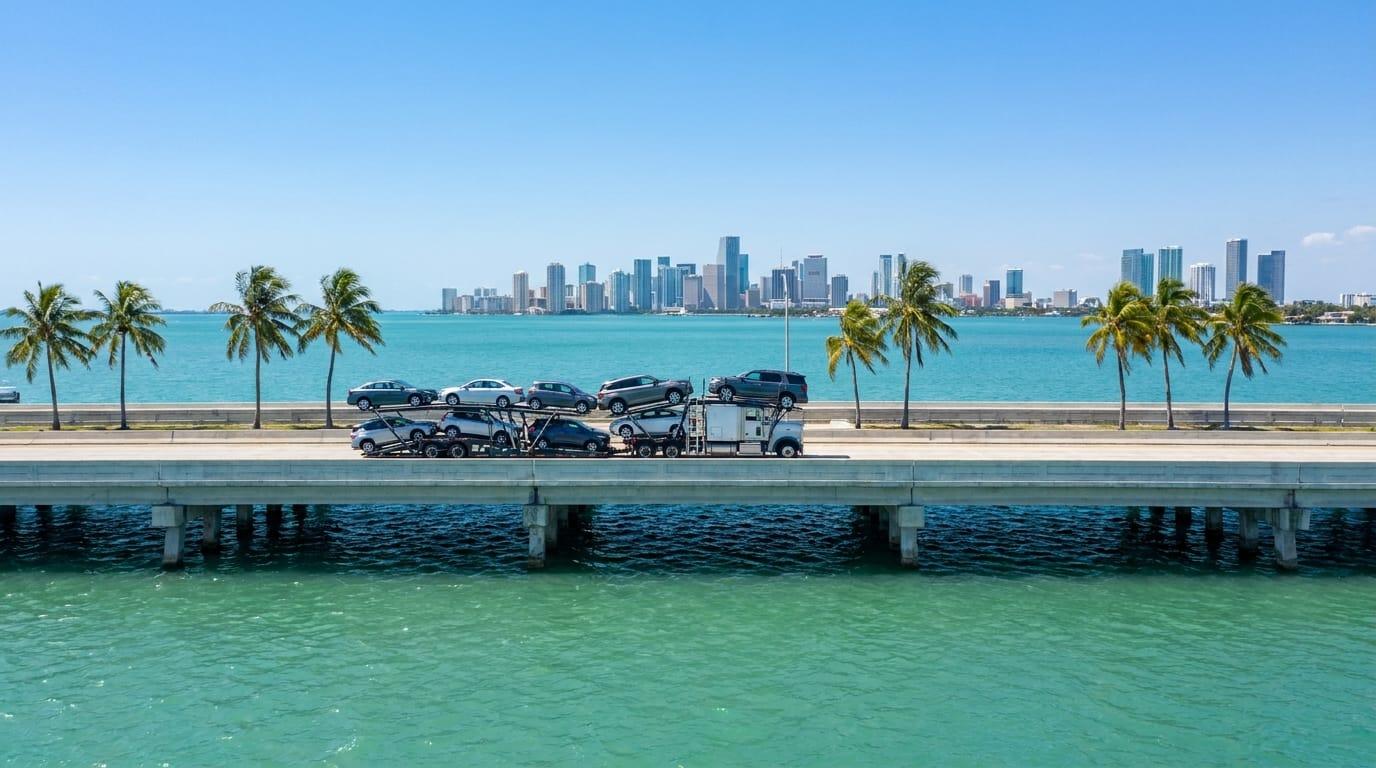
California to Florida car shipping covers one of the longest lanes in the lower 48, roughly 2,400 to 3,000 miles between the major metros. The people on it are a mix: Californians retiring to Sarasota or The Villages, remote workers trading Bay Area rents for Orlando or Tampa, and sailors transferring from San Diego to Naval Station Mayport or NAS Jacksonville. Driving it yourself means four or five long days and several motel nights, which is why so many people choose to ship the car and fly.
California pickups need a little planning. Dense neighborhoods in Los Angeles and San Francisco often call for a meeting spot on a main boulevard, while suburbs in Orange County, the Inland Empire and Sacramento are usually reachable at your door. Because this is a long haul, carriers like to fill every slot on the trailer before leaving California, so your pickup window may be a few days wide. We give you a realistic window up front rather than a promise nobody can keep.
On the Florida end, Sahara Auto Transport is at home. Our office is in Hollywood, in Broward County, and our team handles deliveries across the state every day, from Pensacola on the Panhandle to Key West. We know which Miami-Dade condo buildings need a delivery reservation, which Tampa Bay neighborhoods have low oak canopies over the street, and how hurricane season affects schedules from June through November. That local knowledge matters most in the last few miles, after the carrier has already crossed the whole southern half of the country to reach you.
Pricing
How much it costs to ship a car from California to Florida
Estimated ranges for a typical trip of about 2,610 miles on this route, updated November 2026.
Sedan or coupe
- Open carrier
- $1,400 to $1,775
- Enclosed
- $2,175 to $2,775
SUV, crossover or minivan
- Open carrier
- $1,600 to $2,050
- Enclosed
- $2,500 to $3,175
Pickup or large SUV
- Open carrier
- $1,825 to $2,325
- Enclosed
- $2,825 to $3,600
- These are estimates, not quotes. Your exact price depends on the addresses, vehicle, condition, season and carrier availability.
- Non-running vehicles that need a winch usually add $150 to $250. Peak season and expedited pickup can raise the price.
Following I-10 from coast to coast
Most California to Florida carriers use I-10, which runs from Santa Monica all the way to Jacksonville. After leaving Los Angeles, trucks pass Phoenix, Tucson, El Paso, San Antonio and Houston, then cross Louisiana on the 18-mile Atchafalaya Basin Bridge before reaching Mobile and the Florida Panhandle. Jacksonville-bound cars stay on I-10 to its eastern end, while Orlando, Tampa and South Florida deliveries usually turn south on I-75 near Lake City.
Northern California loads may start differently, running I-5 or CA-99 to Bakersfield and then I-40 east to Amarillo. From there, some drivers drop to Dallas and follow I-20 through Shreveport, Jackson and Birmingham to Atlanta, where I-75 heads straight into Florida. Either way, drivers cover roughly 400 to 500 miles a day, so 6 to 9 days in transit is typical for this cross-country run.
City to city
Popular California to Florida trips
Los Angeles, CA → Miami, FL
2,730 miles · 7 to 9 days
Est. $1,425 to $1,825
Los Angeles, CA → Orlando, FL
2,520 miles · 6 to 8 days
Est. $1,375 to $1,750
San Diego, CA → Tampa, FL
2,400 miles · 6 to 8 days
Est. $1,350 to $1,725
San Francisco, CA → Jacksonville, FL
2,700 miles · 7 to 9 days
Est. $1,425 to $1,800
Sacramento, CA → Fort Lauderdale, FL
3,000 miles · 7 to 10 days
Est. $1,500 to $1,900
Riverside, CA → Pensacola, FL
2,020 miles · 5 to 7 days
Est. $1,250 to $1,575
Transit times start at pickup. Prices are November 2026 estimates for a running sedan on an open carrier, not quotes.
Seasonal demand from California to Florida
Demand into Florida climbs every fall as retirees and seasonal residents settle in before winter, and that pull reaches all the way to the West Coast. October through December is the busiest stretch for this direction, and January stays active. Summer brings family relocations timed to the school year, but Florida's hurricane season, which runs June through November, means a storm on the Gulf Coast can hold a delivery for a day or two.
Winter is a good season for the drive itself because I-10 rarely sees snow, though the occasional ice event in Texas or Louisiana can slow things briefly. The I-40 alternative through Flagstaff can close during winter storms, and carriers simply reroute south when it does. If your dates are flexible, late spring is often the calmest time to book space heading to Florida.
Before you book
Tips for this route
- Plan for a cross-country pickup window. Carriers on long lanes often need a few days to assemble a full load, so book your flight after the pickup date is confirmed.
- If your Florida delivery falls in late summer or fall, give us a backup contact who can receive the car in case a storm forces you to change plans.
- Shipping an EV across the country? Charge it to roughly half and leave the charging cable in the car. The driver needs to move it on and off the trailer but typically cannot charge it en route.
- Florida will ask for a VIN verification and proof of a Florida insurance policy when you register, so keep your California title and registration somewhere safe and handy.
- Remove your FasTrak transponder and clear out loose electronics before pickup. A coast-to-coast trip means many hours on the road, and loose items can shift or go missing.