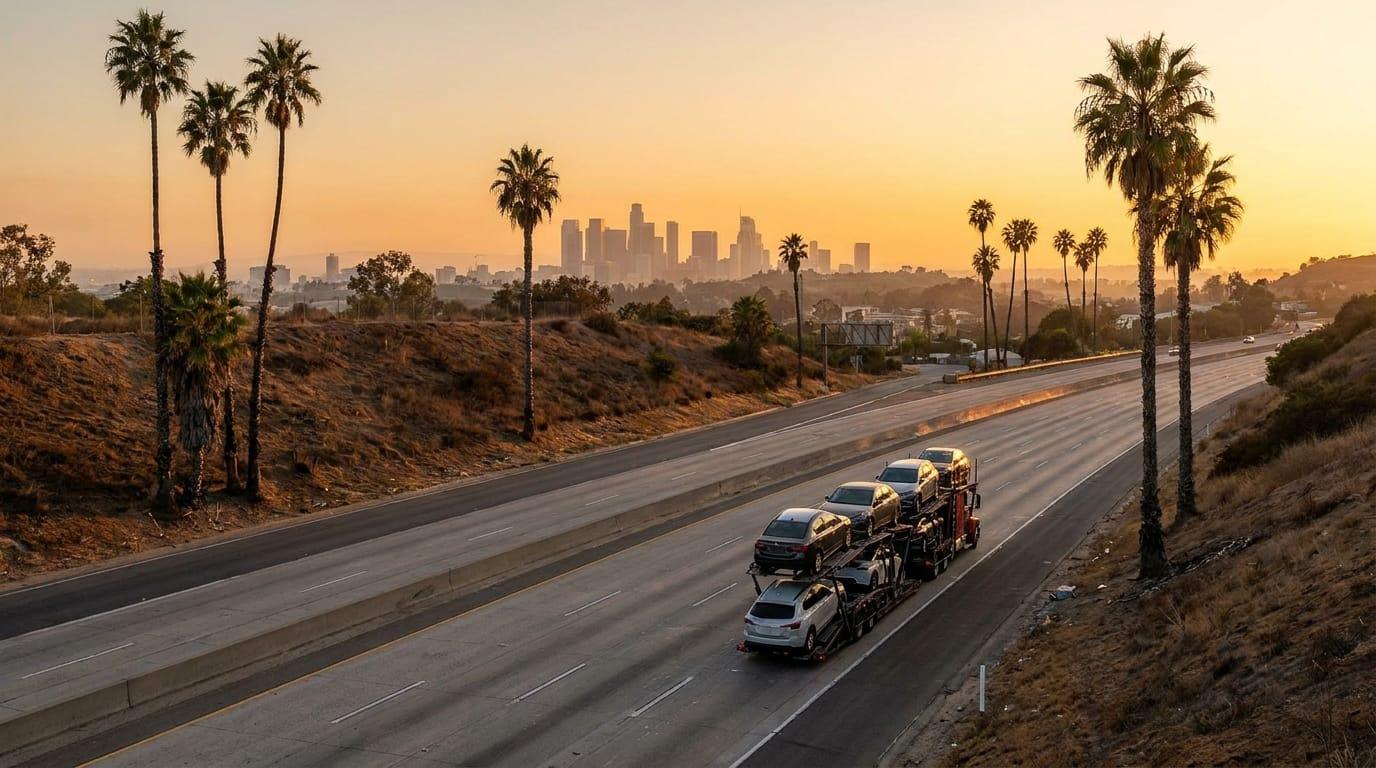
California car shipping is high-volume work. Los Angeles, the largest city, along with San Diego, the Bay Area and Sacramento, make up some of the busiest auto transport markets in the country, and carriers run in and out on I-5, I-10, I-15, I-40 and I-80 every day. That traffic is good news if you need to ship a car to California or out of it, because there is usually a truck heading your way. It also means demand swings with the seasons, so a little planning pays off on price and timing.
Moving a car into California comes with paperwork other states do not require. The California Air Resources Board, or CARB, sets emission standards stricter than federal rules, and most gasoline vehicles coming from out of state need a smog check before the DMV will issue California plates. Buying a new car elsewhere can be tricky too, since vehicles with fewer than 7,500 miles generally must be California-certified to register here. Sahara Auto Transport cannot handle DMV steps for you, but we will flag these issues before you book so nothing catches you off guard.
Inside the state, distances are bigger than many people expect. Los Angeles to San Francisco is roughly 380 miles on I-5, and San Diego to Sacramento is close to 500. Coastal neighborhoods in San Francisco, Santa Monica and La Jolla have steep streets, tight parking and permit rules that keep large carriers out, so curbside meeting points are common. At Sahara we plan around these realities, booking open carriers for everyday vehicles and enclosed trailers for the exotic and classic cars California is known for.
Pickup and delivery
Where we ship in California
Los Angeles
Sprawling and congested, so carriers prefer early pickups on wide streets, and hillside areas like Silver Lake and the Hollywood Hills often need a nearby meeting point.
San Diego
Steady military relocation traffic tied to Naval Base San Diego and Camp Pendleton, with easy carrier access via I-5 and I-15.
San Francisco and Oakland
Steep, narrow streets and scarce parking mean many Bay Area pickups happen at a larger lot or along a wide boulevard.
San Jose
Silicon Valley's largest city sees constant tech relocations, and its suburban street grid is friendlier to car haulers than San Francisco's.
Sacramento
The capital sits where I-5 meets I-80, a convenient stop for carriers heading over Donner Pass to Reno or north to Oregon.
Inland Empire
Riverside and San Bernardino form a logistics hub with heavy truck traffic on I-10 and I-15, plenty of room to load, and snowbird demand toward Palm Springs.
Routes our carriers use
Main corridors in and out of California
I-5
The north to south spine from San Diego through Los Angeles, over the Grapevine at Tejon Pass and up the Central Valley to Sacramento and Oregon.
I-10
Leads east from Santa Monica through the Inland Empire and Palm Springs to Arizona, the main route for southern cross-country carriers.
I-15
Climbs Cajon Pass toward Las Vegas and Salt Lake City, carrying heavy weekend traffic between Southern California and Nevada.
I-80
Runs from the Bay Area through Sacramento and over Donner Pass into Nevada, the gateway to Reno, Salt Lake City and Chicago.
I-40
Starts at Barstow and heads east across the Mojave toward Flagstaff, a common path for shipments to Oklahoma, Tennessee and the Carolinas.
Ports and logistics hubs
- Port of Los Angeles
- Port of Long Beach
- Port of Hueneme in Oxnard, a major import gateway for new vehicles
- Port of Benicia in the Bay Area, which also handles vehicle imports
Transit times
How long shipping from California takes
Phoenix, AZ
370 to 390 miles · 1 to 3 days
Est. $575 to $750
Seattle, WA
1,130 to 1,180 miles · 3 to 5 days
Est. $950 to $1,225
Dallas, TX
1,430 to 1,460 miles · 4 to 6 days
Est. $1,050 to $1,350
New York, NY
2,780 to 2,820 miles · 7 to 10 days
Est. $1,450 to $1,850
Miami, FL
2,720 to 2,760 miles · 7 to 10 days
Est. $1,425 to $1,825
Transit starts once your vehicle is loaded. Prices are November 2026 estimates for a running sedan on an open carrier, not quotes. Ocean shipments to Alaska and Hawaii are priced individually.
Wildfires, winter passes and the summer rush
Summer is California's busiest shipping season. College students, military families and job transfers all move between June and August, and demand for trucks out of Los Angeles and the Bay Area climbs. Winter brings a different wave, as snowbirds head to Palm Springs, Palm Desert and the rest of the Coachella Valley from roughly November to April and back out again in spring. Booking two to three weeks ahead in those windows is wise.
Weather adds its own variables. Wildfire season peaks from late summer through fall, when Santa Ana and Diablo winds can trigger evacuations, road closures and heavy smoke along I-5 or in the foothills. In winter, Caltrans often requires chains or closes I-80 over Donner Pass and I-5 over the Grapevine during storms, which can delay shipments by a day or more. Winter rain occasionally floods or washes out stretches of Highway 101 and Highway 1 along the coast.
Local know-how
Tips for shipping a car in California
- Take your FasTrak transponder out of the car or store it in its shielded bag; otherwise it can be charged as the truck passes Bay Area toll bridges, express lanes or Orange County toll roads.
- Moving in from another state? Expect a smog check for most gasoline vehicles, and check CARB certification before buying a new car out of state.
- California gives new residents only about 20 days to register, shorter than most states; confirm the details with the California DMV.
- In San Francisco, Los Angeles and other dense cities, check parking restrictions and street-sweeping days at the delivery address, or let us arrange a nearby retail lot.
- During wildfire season, watch evacuation alerts near your pickup or delivery address and tell us right away if access changes.