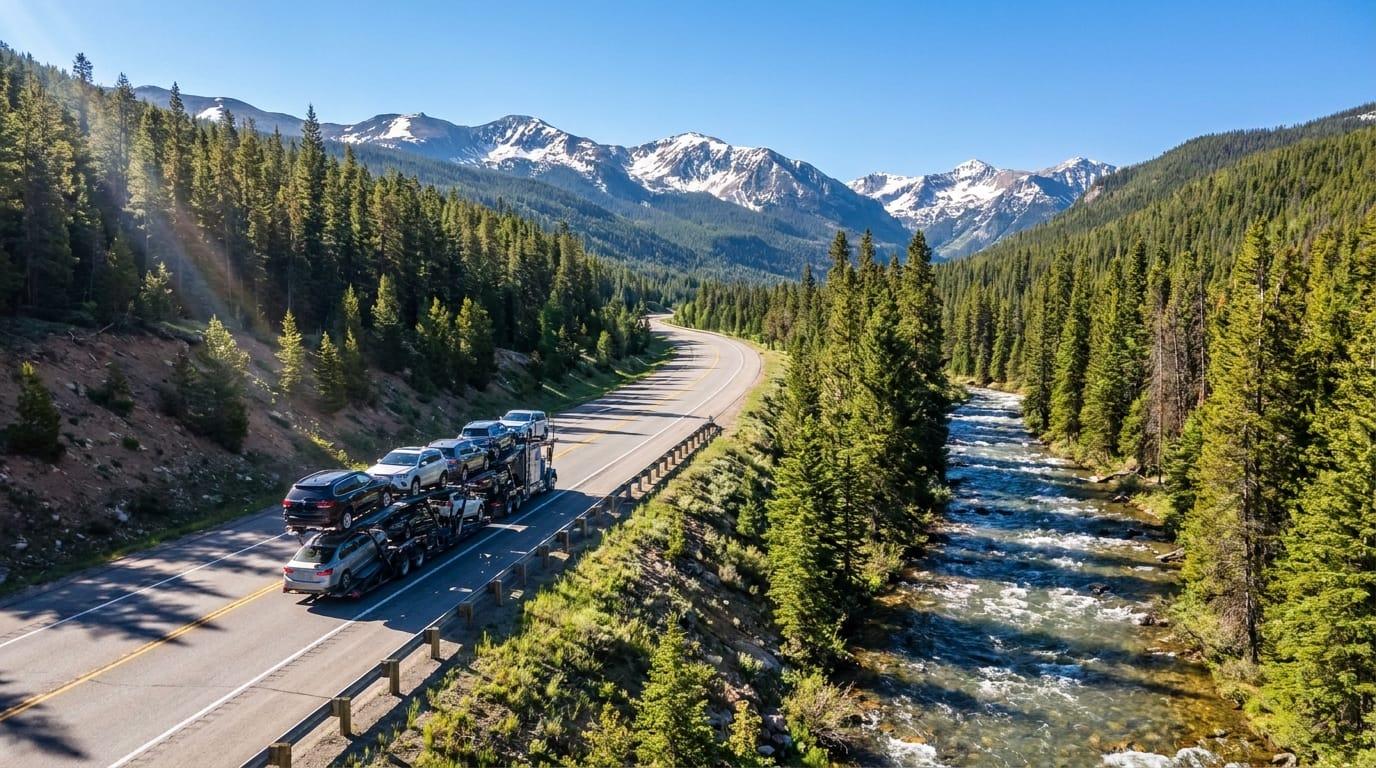
California to Colorado car shipping takes your vehicle from sea level to the Front Range on one of the most dramatic climbs any auto transport route makes. Most trucks that ship a car from California to Colorado run I-15 from Southern California through Las Vegas, then pick up I-70 in central Utah and follow it over the Rockies to Denver. Los Angeles to Denver auto transport typically takes 3 to 5 days after pickup. We arrange door-to-door service for moves to Denver, Aurora, Boulder, Fort Collins, Colorado Springs and the mountain towns.
Many Californians on this lane are trading high housing costs for Front Range suburbs such as Lakewood, Littleton, Highlands Ranch and Castle Rock, or heading to Colorado Springs for an assignment at Fort Carson or one of the Space Force bases. That mix keeps demand steady. Bay Area and Sacramento cars often take a different path, crossing the Sierra Nevada on I-80 over Donner Summit, continuing through Reno and Salt Lake City, and turning south on I-25 at Cheyenne. Your carrier chooses the route based on weather, other stops on the trailer and current road conditions.
The mountains are the key planning factor. I-70 crosses Vail Pass at over 10,600 feet and runs through the Eisenhower Tunnel at more than 11,000 feet, and Colorado's traction and chain laws for commercial vehicles apply on that stretch from September through May. Glenwood Canyon also closes from time to time for rockslides or flash flooding off old burn scars. Sahara Auto Transport sets transit expectations with those realities in mind, and we will tell you if a southern detour on I-40 and I-25 makes more sense for your dates.
Pricing
How much it costs to ship a car from California to Colorado
Estimated ranges for a typical trip of about 1,070 miles on this route, updated November 2026.
Sedan or coupe
- Open carrier
- $925 to $1,175
- Enclosed
- $1,425 to $1,825
SUV, crossover or minivan
- Open carrier
- $1,075 to $1,350
- Enclosed
- $1,650 to $2,100
Pickup or large SUV
- Open carrier
- $1,200 to $1,525
- Enclosed
- $1,850 to $2,375
- These are estimates, not quotes. Your exact price depends on the addresses, vehicle, condition, season and carrier availability.
- Non-running vehicles that need a winch usually add $150 to $250. Peak season and expedited pickup can raise the price.
Mountain routes from California to Colorado
The most common Southern California path runs north on I-15 over Cajon Pass, across the Mojave through Barstow and Las Vegas, then through the Virgin River Gorge into Utah. At Cove Fort, carriers turn east onto I-70, which crosses the San Rafael Swell, a stretch with roughly 100 miles between services east of Salina, then reaches Green River, the Colorado line and Grand Junction.
In Colorado, I-70 follows the Colorado River through De Beque Canyon and Glenwood Canyon, passes Eagle and Vail, climbs Vail Pass and goes through the Eisenhower Tunnel before dropping down the long grade past Georgetown and Idaho Springs into Denver. When winter weather shuts that corridor, carriers may go south on I-40 across Arizona and New Mexico and come up I-25 over Raton Pass, or take I-80 across Wyoming and come down I-25 from Cheyenne. Both alternatives add miles but avoid the I-70 high country.
City to city
Popular California to Colorado trips
Los Angeles, CA → Denver, CO
1,020 miles · 3 to 5 days
Est. $900 to $1,150
San Diego, CA → Colorado Springs, CO
1,080 miles · 3 to 5 days
Est. $925 to $1,175
San Francisco, CA → Denver, CO
1,250 miles · 4 to 6 days
Est. $1,000 to $1,275
Sacramento, CA → Fort Collins, CO
1,100 miles · 4 to 5 days
Est. $925 to $1,200
Los Angeles, CA → Grand Junction, CO
770 miles · 2 to 4 days
Est. $800 to $1,000
Irvine, CA → Boulder, CO
1,060 miles · 3 to 5 days
Est. $925 to $1,175
Transit times start at pickup. Prices are November 2026 estimates for a running sedan on an open carrier, not quotes.
Seasons on the California to Colorado lane
Late spring and summer are peak months for relocations into Colorado. School-year timing, new jobs along the Front Range and generally clear mountain driving push demand up from May through August, and that is when trucks fill fastest out of Los Angeles and the Bay Area. Ski season creates a second, smaller bump from November through January as people send cars to second homes in Summit County, Vail, Steamboat Springs and Aspen.
Winter is when patience pays off. A storm on Vail Pass or a closure at the Eisenhower Tunnel can stop trucks for hours, and commercial drivers must carry chains or traction devices on I-70. We usually quote winter transit with an extra day of cushion. Summer has its own wild card in afternoon thunderstorms and occasional flash flood closures in Glenwood Canyon.
Before you book
Tips for this route
- Colorado sets its own deadline for new residents to register, and registration runs through county motor vehicle offices, so check with the Colorado DMV and your county clerk soon after you arrive.
- If you will live in the Denver or Boulder metro area, your vehicle may need an emissions test through Air Care Colorado before registration, though newer vehicles are often exempt for their first several model years.
- E-470 on the east side of Denver, including the route to Denver International Airport, is all-electronic and billed through ExpressToll or by plate; your FasTrak will not work there.
- Mountain addresses in places like Evergreen, Breckenridge or Estes Park may have steep, narrow roads that a full-size carrier cannot climb, so plan on a meeting point in town.
- Put all-season or winter tires on the car before a November to March shipment so you can drive it safely the day it arrives on the Front Range.